If you’re pregnant, already have kids, work full-time, and are trying to stay active… you already know the struggle.
You’re tired. You’re busy. There’s always something that need to be cleaned, someone who needs a snack, and a to-do list that never seems to get shorter. And most workout content I’ve seen, especially the prenatal ones, feels like they were designed for someone with no other children, who has a gym membership, and at least two uninterrupted hours.
That’s not where I’m at these days. And I’m guessing it might not be where you are either.
I’m a working mom of two toddlers, currently pregnant with my third, and I hold a Master’s degree in Health Sciences with over a decade in clinical research — including several years focused on mental health. I share that not to sound impressive, but because it shapes how I think about wellness and movement. I approach this stuff through an evidence-informed lens, even when I’m doing squats in my living room while Disney’s Coco plays in the background.
I want to be upfront: I’m currently working toward my canfitpro personal training certification, so I’m not yet a certified trainer. What I’m sharing here is what personally works for me — my own routine, in my own home, during my own pregnancy. As always, please check with your healthcare provider before starting or continuing any exercise during pregnancy. That part is non-negotiable
Why I Stopped Waiting for the Perfect Time to Work Out
For me, the most realistic time to move my body is when my kids are already occupied: playing in the living room, running around outside, or doing their own thing nearby. Trying to schedule the “perfect” workout window when you have toddlers is a lesson in frustration. So, I stopped forcing it.
Instead, I started building quick, flexible movement into the pockets of time I actually have. No gym required. No rigid schedule. No childcare needed. If I have 20 minutes and I’m in leggings, I’m fitting something in. (Honestly – you don’t even have to change into gym clothes. That’s a hill I will die on.)
This is the full-body routine I keep coming back to. It’s become one of go-to movement sessions when I need to shake off the fatigue of a long workday, feel a little stronger in my body, and, maybe most importantly, show my kids what it looks like to prioritize your health even when life is busy.
A Few Things Before We Start
Talk to your provider first. Every pregnancy is different. I can share what works for me, but your midwife or OB knows your specific situation. Please get their thumbs-up before starting anything new.
Meet yourself where you are today. Some days I move through this feeling strong and energized. Other days, especially after a rough night, I slow everything down, take longer breaks, and do fewer rounds. The goal is consistent, sustainable movement, not pushing yourself to your limit.
Focus on muscle engagement. My biggest personal tip: rather than rushing through reps, try to concentrate on actually contracting the muscles you’re using. I find I get so much more out of each movement this way, and it keeps me focused even when there’s chaos happening three feet away.
What This Workout Looks Like
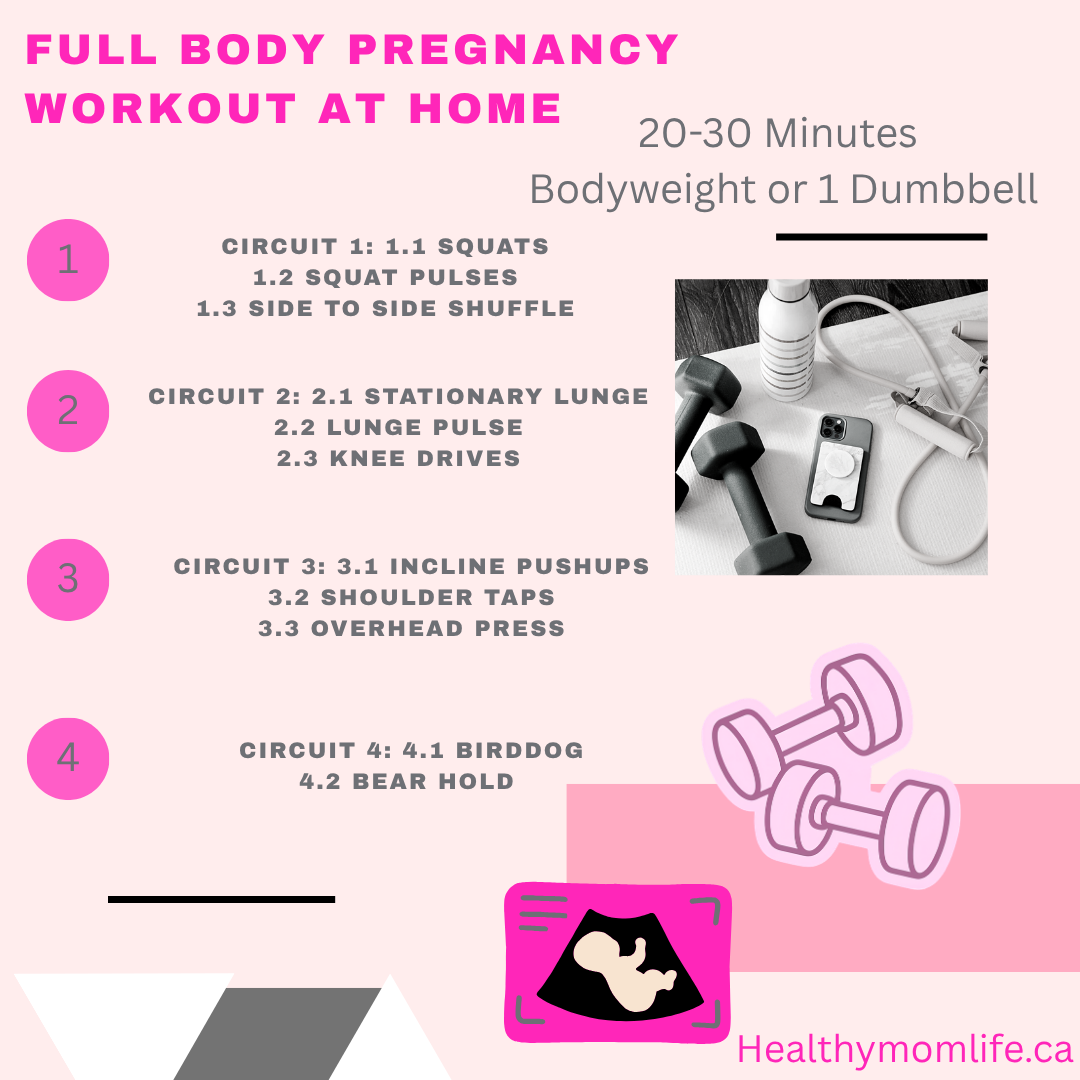
- ⏱ 20–30 minutes total
- 🏡 At home: living room, backyard, wherever your kids are
- 👶 Kid-friendly: no complicated setup, no multiple pieces of equipment to trip over
- 💪 Optional equipment: one heavier dumbbell, access to a wall or bench
The movements are simple and functional. This is the kind of movement that translate directly into real mom life and chasing those toddlers around. We’re talking squats, lunges, lateral movement, pushing, and core work that’s appropriate for pregnancy. Nothing super fancy or anything that might be embarrassing if someone saw you doing it.
How to Create the Timer
Option 1: Interval timer app
Download a tabata or interval or interval timer app on your phone (there are lots of free ones). Set your intervals in advance so you’re not checking the clock during the workout. If you have a smartwatch, you can set intervals there too.
Option 2: Rep-based
Personally, I go back and forth between time-based and rep-based depending on the day. Time-based helps me slow down and not rush through movements. But if you know you’re going to be interrupted or you prefer to track reps, aim for 12–14 reps per exercise and make it work for you.
The Warm-Up (5 minutes)
Move through each of these at your own pace, about 8–10 reps each. You’re looking to feel your body start to wake up and your heart rate gently rise. Take your time and add anything else that feels good.
1. Belly Breathing and Core Engagement
Sitting or standing quietly, take a full breath in, then on the exhale, gently lift your pelvic floor and draw in your side abdominals. I think of it as giving my baby a little hug from the inside. Focus on your posture and try to carry this core awareness into the workout with you. If you’re new to this, look up a short video on diaphragmatic breathing — it’s worth understanding before you jump into the workout.
2. Arm Flaps
Gentle shoulder warm-up.
3. Good Mornings
Hinge at the at the hips, feel the hamstrings wake up.
4. Bent over arm raises
Upper back and shoulder prep. In a hinge position, raise your arms over your head, 45 degrees to the side, and then directly to the side. Cycle through this a few times.
5. Hip lifts into hip circles
Loosen up those hips. Lift your knees one at a time to be level with your hips. Then working on one leg at a time, pretend you’re stepping over a bench or stool.
6. Body weight squats into moving side-to-side squats
Get comfortable with the movement patterns you’ll be repeating. Start with a nice easy squat and increase your range of motion as you warm up. After a few squats, bring your feet together when you stand and then move to the right/left when you squat down.
The Workout
Circuit 1: The Squat (repeat x3)
What you’re working: quads, hamstrings, glutes
1.1 Squat – 30 seconds
Bodyweight, or hold one dumbbell at your chest. Feet hip-width apart (or wider if your belly needs the room). Sit back into an imaginary chair, keeping your weight through your heels and knees tracking toward your outer toes. When you stand back up, focus on squeezing your glutes — no need to thrust your hips forward, just stand up nice and tall.
1.2 Squat pulses – 15 secs on/10 secs rest/15 secs on
Stay at the bottom of your squat and pulse up and down about an inch. This one burns. Sometimes I put my hands on my glutes just to feel the contraction — it helps me stay focused on the right muscles. In your interval timer, set this as one 40-second interval and manage your own rest in the middle.
1.3 Side-to-side shuffle – 30 secs on/15 secs rest
Move laterally — a little skip side to side, touching your opposite hand to your foot. It looks like a moving squat and it will get your heart rate up. Have fun with it.
Rest 10–15 seconds between sets.
2. Circuit 2: The Lunge (repeat x2)
What you’re working: quads, glutes, balance
2.1 Stationary Lunge – 30 seconds
First round on the right, second round on the left. Lead foot forward, back foot behind, feet hip-width apart (not in line — that makes balancing harder, especially with a bump). Drive through the heel of your front foot as you lower and rise.
2.1 Stationary Lunge Pulse – 15 secs on/10 sec on/15 secs on
Hold the bottom of your lunge and pulse up an inch, down an inch. Try to keep your back knee hovering just above the floor rather than resting on it.
2.3 Knee drives – 30 secs on/15 secs rest
From the lunge position, push off your front heel to bring your back knee forward and up as you return to standing. It’s a dynamic movement and it will get your heart rate going. If you’d prefer something lower-impact, swap this for a step-up onto a low bench or stair.
Rest 10–15 seconds between sets.
3. Circuit 3: Chest and Shoulders (repeat x 3)
What you’re working: shoulders, chest, core
3.1 Incline push-up – 30 seconds on
Use a wall or a bench, or anything you have access to that can give you an incline. Hands positioned like you’re about to push a car out of the way. Lead with your chest, keep your core engaged, and lower and press. You can add a little downward dog after each rep if you want to stretch through your back or take a break.
3.2 Shoulder taps – 30 secs on/15 secs rest
In an incline plank position on a wall or bench, tap your opposite hand to your opposite shoulder, alternating sides. Keep your hips as still as possible and make sure to breathe.
3.3 Overhead dumbbell press (30 seconds on, 15 seconds off)
- If you’re doing a bodyweight workout, just change this to jack taps (aka. jumping jacks with a side to side tap instead of a jump). You can get fancy and change the side-to-to taps to 45 degrees in front or in the back instead.
Rest 10–15 seconds between sets.
4. Circuit 4: Pregnancy-Safe Core (repeat x2)
What you’re working: deep core, stability, balance
4.1 Bird dog – 30 secs on/10 sec rest
On hands and knees, extend opposite arm and leg simultaneously. Slow and controlled — the extension itself is the work. Keep your back flat and your core braced.
4.2 Bear hold – 30 secs on/ 10 sec rest
On hands and knees, brace your core and lift your knees just an inch or two off the floor. Hold for a count of 3, lower, reset, and repeat. This one looks simple but is deceptively hard. Your core is doing a lot.
Rest 10–15 seconds between sets.
Cool-Down (2-5 minutes):
Take your time here — especially during pregnancy, your body has worked hard.
- Overhead arm reaches and side stretches
- Hamstring and quad stretches
- Seated figure-4 hip stretch
- Cross-body arm stretches
Pregnancy Modifications (What I Actually Do)
- Slow everything down — shorter range of motion is completely fine
- Take longer breaks or drop a round if you need to
- Keep breathing — never hold your breath during any movement
- Stop immediately if anything feels off, sharp, or wrong
One Last Thing
Any movement is better than no movement. Even 10 minutes of this is a win. It’s okay if you get interrupted mid-circuit, if your form isn’t absolutely picture perfect, or if a toddler climbs on your back during bird dogs. (This has happened to me. Multiple times.)
The goal here is consistent, joyful movement that supports your body and your baby. We want this to energize you, not drain you. And if your kids end up joining in? That might honestly be the best part.
As always, please consult your healthcare provider before beginning or modifying any exercise routine during pregnancy. This post reflects my personal routine and experience — it is not professional medical or fitness advice.