Tag: pregnancy

  • The Living Room Workout I Actually Do While My Kids Are Running Around

    The Living Room Workout I Actually Do While My Kids Are Running Around

    If you’re pregnant, already have kids, work full-time, and are trying to stay active… you already know the struggle.

    You’re tired. You’re busy. There’s always something that need to be cleaned, someone who needs a snack, and a to-do list that never seems to get shorter. And most workout content I’ve seen, especially the prenatal ones, feels like they were designed for someone with no other children, who has a gym membership, and at least two uninterrupted hours.

    That’s not where I’m at these days. And I’m guessing it might not be where you are either.

    I’m a working mom of two toddlers, currently pregnant with my third, and I hold a Master’s degree in Health Sciences with over a decade in clinical research — including several years focused on mental health. I share that not to sound impressive, but because it shapes how I think about wellness and movement. I approach this stuff through an evidence-informed lens, even when I’m doing squats in my living room while Disney’s Coco plays in the background.

    I want to be upfront: I’m currently working toward my canfitpro personal training certification, so I’m not yet a certified trainer. What I’m sharing here is what personally works for me — my own routine, in my own home, during my own pregnancy. As always, please check with your healthcare provider before starting or continuing any exercise during pregnancy. That part is non-negotiable


    Why I Stopped Waiting for the Perfect Time to Work Out

    For me, the most realistic time to move my body is when my kids are already occupied: playing in the living room, running around outside, or doing their own thing nearby. Trying to schedule the “perfect” workout window when you have toddlers is a lesson in frustration. So, I stopped forcing it.

    Instead, I started building quick, flexible movement into the pockets of time I actually have. No gym required. No rigid schedule. No childcare needed. If I have 20 minutes and I’m in leggings, I’m fitting something in. (Honestly – you don’t even have to change into gym clothes. That’s a hill I will die on.)

    This is the full-body routine I keep coming back to. It’s become one of go-to movement sessions when I need to shake off the fatigue of a long workday, feel a little stronger in my body, and, maybe most importantly, show my kids what it looks like to prioritize your health even when life is busy.


    A Few Things Before We Start

    Talk to your provider first. Every pregnancy is different. I can share what works for me, but your midwife or OB knows your specific situation. Please get their thumbs-up before starting anything new.

    Meet yourself where you are today. Some days I move through this feeling strong and energized. Other days, especially after a rough night, I slow everything down, take longer breaks, and do fewer rounds. The goal is consistent, sustainable movement, not pushing yourself to your limit.

    Focus on muscle engagement. My biggest personal tip: rather than rushing through reps, try to concentrate on actually contracting the muscles you’re using. I find I get so much more out of each movement this way, and it keeps me focused even when there’s chaos happening three feet away.


    What This Workout Looks Like

    • 20–30 minutes total
    • 🏡 At home: living room, backyard, wherever your kids are
    • 👶 Kid-friendly: no complicated setup, no multiple pieces of equipment to trip over
    • 💪 Optional equipment: one heavier dumbbell, access to a wall or bench

    The movements are simple and functional. This is the kind of movement that translate directly into real mom life and chasing those toddlers around. We’re talking squats, lunges, lateral movement, pushing, and core work that’s appropriate for pregnancy. Nothing super fancy or anything that might be embarrassing if someone saw you doing it.


    How to Create the Timer

    Option 1: Interval timer app

    Download a tabata or interval or interval timer app on your phone (there are lots of free ones). Set your intervals in advance so you’re not checking the clock during the workout. If you have a smartwatch, you can set intervals there too.

    Option 2: Rep-based

    Personally, I go back and forth between time-based and rep-based depending on the day. Time-based helps me slow down and not rush through movements. But if you know you’re going to be interrupted or you prefer to track reps, aim for 12–14 reps per exercise and make it work for you.


    The Warm-Up (5 minutes)

    Move through each of these at your own pace, about 8–10 reps each. You’re looking to feel your body start to wake up and your heart rate gently rise. Take your time and add anything else that feels good.

    1. Belly Breathing and Core Engagement

    Sitting or standing quietly, take a full breath in, then on the exhale, gently lift your pelvic floor and draw in your side abdominals. I think of it as giving my baby a little hug from the inside. Focus on your posture and try to carry this core awareness into the workout with you. If you’re new to this, look up a short video on diaphragmatic breathing — it’s worth understanding before you jump into the workout.

    2. Arm Flaps

    Gentle shoulder warm-up.

    3. Good Mornings

    Hinge at the at the hips, feel the hamstrings wake up.

    4. Bent over arm raises

    Upper back and shoulder prep. In a hinge position, raise your arms over your head, 45 degrees to the side, and then directly to the side. Cycle through this a few times.

    5. Hip lifts into hip circles

    Loosen up those hips. Lift your knees one at a time to be level with your hips. Then working on one leg at a time, pretend you’re stepping over a bench or stool.

    6. Body weight squats into moving side-to-side squats

    Get comfortable with the movement patterns you’ll be repeating. Start with a nice easy squat and increase your range of motion as you warm up. After a few squats, bring your feet together when you stand and then move to the right/left when you squat down.

    The Workout

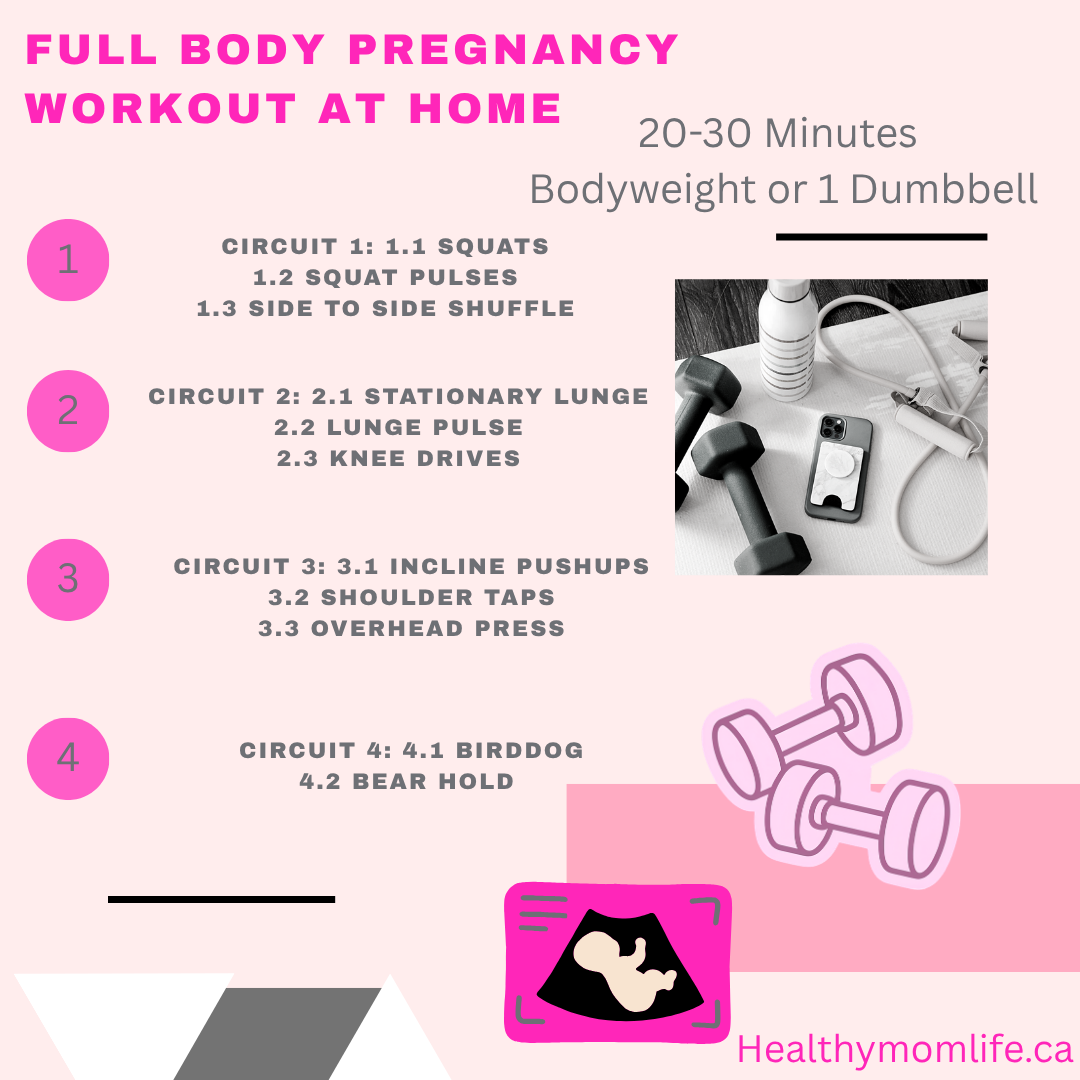
    Circuit 1: The Squat (repeat x3)

    What you’re working: quads, hamstrings, glutes

    1.1 Squat – 30 seconds

    Bodyweight, or hold one dumbbell at your chest. Feet hip-width apart (or wider if your belly needs the room). Sit back into an imaginary chair, keeping your weight through your heels and knees tracking toward your outer toes. When you stand back up, focus on squeezing your glutes — no need to thrust your hips forward, just stand up nice and tall.

    1.2 Squat pulses – 15 secs on/10 secs rest/15 secs on

    Stay at the bottom of your squat and pulse up and down about an inch. This one burns. Sometimes I put my hands on my glutes just to feel the contraction — it helps me stay focused on the right muscles. In your interval timer, set this as one 40-second interval and manage your own rest in the middle.

    1.3 Side-to-side shuffle – 30 secs on/15 secs rest

    Move laterally — a little skip side to side, touching your opposite hand to your foot. It looks like a moving squat and it will get your heart rate up. Have fun with it.

    Rest 10–15 seconds between sets.


    2. Circuit 2: The Lunge (repeat x2)

    What you’re working: quads, glutes, balance

    2.1 Stationary Lunge – 30 seconds

    First round on the right, second round on the left. Lead foot forward, back foot behind, feet hip-width apart (not in line — that makes balancing harder, especially with a bump). Drive through the heel of your front foot as you lower and rise.

    2.1 Stationary Lunge Pulse – 15 secs on/10 sec on/15 secs on

    Hold the bottom of your lunge and pulse up an inch, down an inch. Try to keep your back knee hovering just above the floor rather than resting on it.

    2.3 Knee drives – 30 secs on/15 secs rest

    From the lunge position, push off your front heel to bring your back knee forward and up as you return to standing. It’s a dynamic movement and it will get your heart rate going. If you’d prefer something lower-impact, swap this for a step-up onto a low bench or stair.

    Rest 10–15 seconds between sets.


    3. Circuit 3: Chest and Shoulders (repeat x 3)

    What you’re working: shoulders, chest, core

    3.1 Incline push-up – 30 seconds on

    Use a wall or a bench, or anything you have access to that can give you an incline. Hands positioned like you’re about to push a car out of the way. Lead with your chest, keep your core engaged, and lower and press. You can add a little downward dog after each rep if you want to stretch through your back or take a break.

    3.2 Shoulder taps – 30 secs on/15 secs rest

    In an incline plank position on a wall or bench, tap your opposite hand to your opposite shoulder, alternating sides. Keep your hips as still as possible and make sure to breathe.

    3.3 Overhead dumbbell press (30 seconds on, 15 seconds off)

    • If you’re doing a bodyweight workout, just change this to jack taps (aka. jumping jacks with a side to side tap instead of a jump). You can get fancy and change the side-to-to taps to 45 degrees in front or in the back instead.

    Rest 10–15 seconds between sets.


    4. Circuit 4: Pregnancy-Safe Core (repeat x2)

    What you’re working: deep core, stability, balance

    4.1 Bird dog – 30 secs on/10 sec rest

    On hands and knees, extend opposite arm and leg simultaneously. Slow and controlled — the extension itself is the work. Keep your back flat and your core braced.

    4.2 Bear hold – 30 secs on/ 10 sec rest

    On hands and knees, brace your core and lift your knees just an inch or two off the floor. Hold for a count of 3, lower, reset, and repeat. This one looks simple but is deceptively hard. Your core is doing a lot.

    Rest 10–15 seconds between sets.


    Cool-Down (2-5 minutes):

    Take your time here — especially during pregnancy, your body has worked hard.

    • Overhead arm reaches and side stretches
    • Hamstring and quad stretches
    • Seated figure-4 hip stretch
    • Cross-body arm stretches

    Pregnancy Modifications (What I Actually Do)

    • Slow everything down — shorter range of motion is completely fine
    • Take longer breaks or drop a round if you need to
    • Keep breathing — never hold your breath during any movement
    • Stop immediately if anything feels off, sharp, or wrong

    One Last Thing

    Any movement is better than no movement. Even 10 minutes of this is a win. It’s okay if you get interrupted mid-circuit, if your form isn’t absolutely picture perfect, or if a toddler climbs on your back during bird dogs. (This has happened to me. Multiple times.)

    The goal here is consistent, joyful movement that supports your body and your baby. We want this to energize you, not drain you. And if your kids end up joining in? That might honestly be the best part.

    As always, please consult your healthcare provider before beginning or modifying any exercise routine during pregnancy. This post reflects my personal routine and experience — it is not professional medical or fitness advice.

  • Why I’m Cutting Back on Added Sugar During Pregnancy (And How I’m Doing it Realistically)

    Why I’m Cutting Back on Added Sugar During Pregnancy (And How I’m Doing it Realistically)

    For those of us who live in Ontario, it may come as a bit of a surprise considering the weather is still absolutely awful, but the 20th of March marked the first official day of Spring!

    Some days still feel a little wintery, but the birds are starting to chirp, the day is longer, and I’m starting to think about what I’m planting in my garden. Warmer weather here we come!

    To me, spring always feels like New Years Resolutions season 2.0. It’s a chance to reflect on your January goals and pare down what’s working, what’s not, and what needs adjusting. Maybe the whole 5 days a week in the gym has been too much of a slog, and you need to pivot to something different. Running outside perhaps? Or maybe you chickened out of signing up for that art class you said you’d do? Try again! Make spring your 2026 refinement season.

    This spring, I’m making one big adjustment: I’m cutting back on added sugar.

    Why I’m Cutting Back on Added Sugar

    Please ignore my dirty mirror. It’s much harder to find the time to take cute bump photos this time around!

    For those who haven’t read my previous post, I’m currently pregnant with my third baby.

    In my past two pregnancies, I was diagnosed with Intrahepatic Cholestasis of Pregnancy, a liver condition that can become dangerous for your baby if not managed carefully.

    During my second pregnancy, things escalated quickly at 37 weeks, leading to a scheduled immediate c-section. It was a stressful and overwhelming experience. And something I’m really hoping to avoid this time around.

    So now, I’m focusing on supporting my body as much as possible. Given that I want to give my liver the best chance it can have to support my pregnancy. Reducing added sugar is one of the ways I’m doing that.

    Of course, this is just my personal approach. Always check with your healthcare provider before making dietary changes during pregnancy.

    What is Added Sugar?

    Added sugar refers to sugars that are added to foods during processing or preparation, rather than naturally occurring.

    Common sources include:

    • Cane sugar
    • Corn syrup / high-fructose corn syrup
    • Honey
    • Agave
    • Syrups and sweeteners in packaged foods

    You’ll often find added sugars in:

    • Granola bars
    • Flavoured yogurt
    • Cereals
    • Baked goods
    • Sauces and dressings

    Research has linked high intake of added sugars to things like tooth decay, energy crashes, and increased risk of conditions like Type 2 Diabetes and heart disease.

    Natural Sugar vs. Added Sugar

    I’m not eliminating sugar entirely.

    Foods like fruit and milk contain natural sugars, and they also come with nutrients like fibre, protein, and vitamins.

    Instead, I’m being more mindful of my overall sugar intake—especially from processed foods.

    My 10 Tips on How to Reduce Added Sugar

    1. Have a strong “why“: Behaviour change is hard. Having a meaningful reason makes it easier to stay consistent.
    2. Plan ahead: Keep lower-sugar snacks on hand so you’re not caught off guard.
    3. Understand your triggers: For me, it’s after meals, especially lunch. I now plan alternatives like fruit, a walk, or a distraction.
    4. Expect hard days: Some days will feel easy, others won’t. That’s normal.
    5. Build a support system: Having someone to talk to makes a huge difference.
    6. Out of sight, out of mind: If it’s not visible, you’re less likely to reach for it.
    7. Read labels: Sugar hides in more foods than you’d expect.
    8. Be flexible: No one likes to say no to birthday cake on their friend’s birthday. Enjoy special occasions without guilt.
    9. Pay attention to how you feel: I notice I feel more sluggish after eating a lot of added sugar. That in itself is motivating.
    10. Keep it positive: Think of this as a challenge, not a restriction.

    My Current Go-To Snacks to Reduce Added Sugar:

    Here are some of my current favourites:

    Unsweetened Applesauce

    Eggs (a complete protein with all 9 essential amino-acids)

    Greek Yogurt or Cottage Cheese with a small amount of maple syrup and peanut butter

    Fruit (especially oranges, pineapple, and frozen berries with milk)

    Cheese for protein and satiety

    Electrolytes for hydration and subtle sweetness

    Pickles or savoury snacks to curb sweet cravings

    What I’ve Learned So Far

    This has been eye-opening.

    Before this, I would have said I eat very healthy—but I didn’t realize how much added sugar was sneaking into my day through snacks and small “pick-me-ups.”

    Now, I’m focusing more on:

    • Protein-rich foods
    • Balanced meals
    • Being intentional about what I eat

    Final Thoughts: Try a “Reduced Sugar Spring”

    Reducing added sugar isn’t about perfection—it’s about awareness.

    It’s about noticing how your body feels, making small adjustments, and building habits that actually work for your life.

    So if you’re looking for a reset, consider this your invitation:

    👉 Try a Reduced Sugar Spring

    Start small, stay flexible, and see how you feel.

  • I Didn’t Expect This During My Third Pregnancy: Anxiety

    I Didn’t Expect This During My Third Pregnancy: Anxiety

    Is Anxiety During Pregnancy Normal?

    Anxiety during pregnancy is actually very common. Many expectant mothers experience moments of worry, racing thoughts, or feeling overwhelmed — especially if they’ve had complications in previous pregnancies. The challenge can be knowing when these feelings are normal pregnancy worries and when they might be signs of prenatal anxiety.

    I’m pregnant with my third baby! Since this is my third “rodeo”, a lot of things have felt very familiar, but what I didn’t expect this time around was the anxiety that came with it.

    We’re over the moon excited to be expanding our family and I daydream daily about the full table I’ll have filled with love. However, I’ve been struggling with moments of feeling overwhelmed and just a general sense of unease that’s making it hard to lean into the bittersweet moments of what will be my last pregnancy.

    My Experience with Pregnancy Anxiety:

    For me, I’ve had intrahepatic cholestasis of pregnancy for my first two pregnancies (let me know if you’d like me to write a post about my experiences with it!). Because I’ve had it before, I know I’ll likely get it again. That makes it hard not to be hypersensitive to every little itch on my hands and feet. One small twinge can send me into a thought spiral of “this is it, I have it again” and my brain refuses to listen to reason. I.e. like it’s pretty early to be getting it, your skin is just dry, the itching went away etc.. etc.. Also, I will be having a C-Section and the idea of another surgery and recovery is something that does scare me.

    And oh man, the number of “what if…?” questions that pop into my head have been really tough. There are so many horror stories online and there truly is a balance to staying informed versus being overburdened with the worst-case scenarios.

    Some days are really good, especially when the February sun is out and the birds are chirping. Other days, I’m a tightly wound ball of nerves that could have a little “menty-b” (mental breakdown) if a sad song comes on my playlist. Some country songs honestly need to be outlawed on public radio.

    In the evenings, after a long day of working full-time and running after my two littles, I also feel like the only thing my brain can focus on is worry. It’s like it says, “hey girlie, which worry from your suuuuuper long list do you want to tackle tonight? If you’re feeling up to it, we can cycle through 2! or even 3!”

    So, I’ve been asking myself, “is this normal?” And I looked into it.

    The short answer is: yes, it is.

    The long answer is: if it’s affecting you daily, there are solutions, and you’re not alone.

    So, if you’re experiencing something similar, please breathe a sigh of relief and take a relaxing nap or a bath, because everything will be ok.


    Normal Pregnancy Worry vs Prenatal Anxiety:

    Anxiety can be a big scary word that gets tossed around easily and it is a normal part of life even outside of being pregnant. But anxiety does exist on a spectrum with fluctuations being common. Pregnancy in particular, with all its hormonal shifts, sleep problems, birth anticipation, and work/life/family changes, can all contribute to feelings of anxiety and lack of control.

    However, normal pregnancy worry is often something that is transient. Meaning that it comes and goes. Today can be better than yesterday or even your afternoon can be better than your morning. Normal worry is often tied to specific triggers, like watching a particularly traumatic news segment or hearing your neighbor talk about their birth story. Further, this worry does get worse when you’re tired or stressed and you just don’t have the mental strength to overcome it or think clearly.

    Overall, normal pregnancy worry is just a small part of your day or week, it doesn’t feel like it’s consuming you or taking over your life. If you’re struggling with leaving your home, interacting with others, or ruminating for days, then it’s possible that you might have “prenatal anxiety”.

    Prenatal anxiety is persistent worry that consumes most days of your week. Often, it can result in trouble sleeping due to worry. I know sleep can be elusive during pregnancy, but this is a sleep disturbance beyond the common aches and pains of pregnancy. It is feeling constantly on edge or keyed up. Generally, with prenatal anxiety, moms-to-be report extreme difficulty in enjoying their pregnancy.


    How to Cope with Pregnancy Anxiety:

    So, if pregnancy anxiety is normal—but still overwhelming—what can you actually do about it? You can:

    1. Name the feeling: simply acknowledging that you’re feeling anxious can help you work towards feeling better.
    2. Keep a journal or diary and write down the thoughts that are causing you worry. Sometimes putting them down on paper minimizes the impact that they have.
    3. Reduce your triggers. If a certain social media account just gets you spiraling every time, no matter how good-intentioned it is, maybe it’s time to mute them or take a social media break. Honestly, we could all do this.
    4. Create a routine that you follow when you feel anxious or create a list of things that you know make you feel good. This could be calling a friend/family member, listening to music, getting some movement in, or just walking outside and breathing fresh air. Find what works specifically for you.
    5. Give yourself permission to rest. This one is hard, especially if you have other young children that you’re responsible for. But maybe, you just request an evening to yourself if you’re able to do so. Perhaps your husband does bath time, or maybe your mother-in-law bakes cookies with them? Find an hour to yourself if you can and use that time to rest and recharge.
    6. Take something off your plate. Are you feeling extra overwhelmed because trying to cook dinner with your kids screaming and crying after school is just too much? Can you sign up for a meal service? Or try meal prepping on the weekend when you have more flexibility. Let go of perfection and maybe also lean into chicken nuggets and frozen peas for a little while. Similarly, maybe the laundry just doesn’t get folded. Your family will still be able to get dressed if their clothes are in a pile. Better yet, off-load your chores to someone else. You’re growing a baby for goodness sakes!
    7. Create a happiness list. I have photos of my kids, happy TV shows, rom-com audio books and feel-good music on my rotation that I cycle through when I want a boost of dopamine. It’s also a great way to remind yourself that good things exist outside of your racing thoughts.
    8. Lean into what you can control. I believe pregnancy is particularly stressful for me because I don’t have constant feedback on how everything is going in my belly. For my situation, what I can control is my diet, exercise, and mindset. I can avoid sugar (which I’ve read can exacerbate cholestasis), and I can say positive things to myself.

    When to Talk to a Doctor:

    If you’re finding that more often than not, you’re feeling like your anxiety is taking over and the strategies above just are not working for you, it might be time to reach out to someone who can help. It’s important to know that this is something that you should not have to struggle through, there is help available and while reaching out might be the hardest step, it does not mean there is anything wrong with you or that you are less than.

    Primary care providers (or your OB/GYN) are here to support you and can provide referrals to mental health services, therapists, and in certain cases can suggest medications or treatments that will make a huge difference.

    Please reach out if you or your family is noticing that:

    • Your anxiety is increasing and does not seem to be ebbing and flowing
    • Your sleep is consistently disrupted, broken, or just “not enough”
    • You are feeling like you’re unable to cope with daily tasks, you’re ruminating for days, and things that once brought you joy no longer do.

    Asking for help does not mean you’re weak or broken. It actually means you are strong and you care about yourself, your family, and your baby. No one should have to experience this, especially not alone, and there are solutions.


    Pregnancy Is Hard and You’re Not Alone:

    Growing a baby is tough stuff. And while a lot of it is viewed with rose coloured glasses, there are some aspects of pregnancy that are nerve-racking, scary, and confusing.

    Know that fluctuations in your mood are normal and that you’re not the only pregnant person who feels this way. But also know, that if you feel something is off and you’re really struggling or lacking support, there are people who want to help you.

    Pregnancy can be beautiful, but it can also be overwhelming and uncertain.

    If you’re feeling anxious, worried, or just not like yourself right now, please know that you’re not alone. Many moms experience this—even during pregnancies they deeply wanted and planned.

    Give yourself grace. You’re doing something incredible.

    Sources:

    • American College of Obstetricians and Gynecologists
    • March of Dimes – Mental health during pregnancy
    • Postpartum Support International – Perinatal anxiety information