Category: Stay-at-Home Moms

  • Easy Strategies to Improve “Mom Brain”

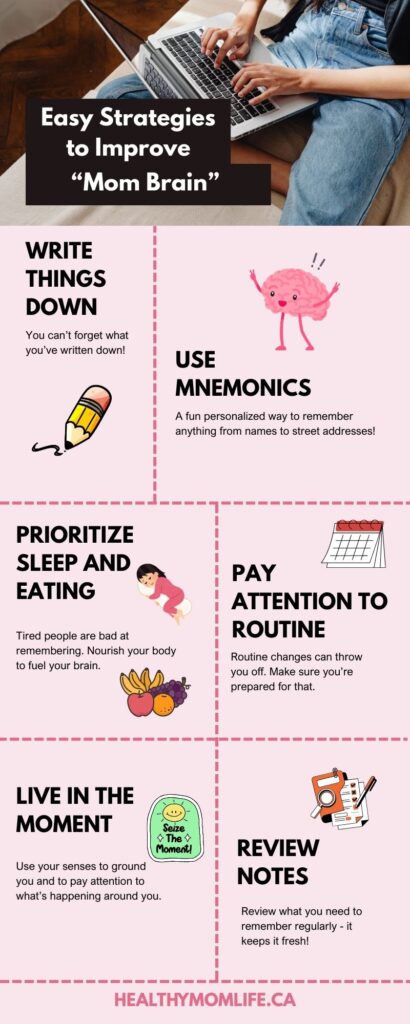
    Easy Strategies to Improve “Mom Brain”

    My New Year’s Resolution this year was to learn names. I know – it’s very basic and a bit embarrassing. As I’ve gotten older, I’ve realized how awful my excuse of “I’m just terrible with faces” is – it makes me sound lazy and flippant. And c’mon, everyone likes to be remembered. The moment someone I’ve met only briefly remembers my name or one of my kid’s names, I’m instantly impressed, and I like them even more.

    However, I’m in the thick of parenting with two small kids under 3, and I find my brain just isn’t firing quite like it used to. The lack of sleep, lack of R&R, constant housework, and returning to work have led to the perfect storm of “mom brain”.

    Mom Brain: the forgetfulness and brain fog that occurs after having a child

    So, if you’re like me and find that some thoughts just *poof* disappear from your head if you’re not careful, then here are a couple tips that you can start using to improve your memory and combat “mom brain”.

    Tip #1: Write things down

    This is the biggest and best thing you can do to help you remember something. The list could probably stop here if I wanted it to.

    Basically, if there is something important you need to remember, you should write it down. At work, I’ve started volunteering to take meeting notes, just because it forces me to a) pay attention and b) have a copy of what happened that I’ve transcribed. This makes me more aware of what happened in the meeting mostly because I either remember it being said or I remember physically writing (or typing) it.

    For my day-to-day, I have a few notes saved to my phone that hit on important things in my life. Like my to-do list, grocery list, meal list, book list, ideas list etc… If I don’t write down a thought I have, it’s gone. Similarly, once you book an appointment, put that directly into your calendar. Don’t wait to do it later, put it directly into your phone’s calendar ASAP.

    Tip #2: Try to Prioritize Sleep

    I’m sorry to include this in my list – but you do need sleep. You’ll be fighting a losing battle without it. Now, I’m not trying to tell you to go to bed at 8:00pm, because for some families with littles, that’s unfortunately not realistic. What I am trying to say is: evaluate how you feel. If you’re a little spacey, on edge, or just not feeling yourself, maybe go to bed instead of watching another episode of Netflix.

    Tip #3: Use Mnemonics

    Whenever I think of mnemonics, I’m immediately transported back to grade school history and trying to memorize dates with my mom before a test. I find mnemonics to be boring, but they do work.

    Essentially, they’re a personalized memory hack – it can be special patterns, rhymes, songs, or stories to help you create an association in your mind for whatever it is you want to remember.

    For example, there is an emotional support dog in my office building. He’s absolutely adorable and I want to remember this cutie-patootie’s name. His name is “Jack”. He’s unfortunately missing one of his eyes. Pirates wear an eye-patch to cover one of their eyes. Captain Jack Sparrow is a famous pirate. Ergo, I think of Captain Jack when I see him and remember that “Jack” is this pup’s name.

    I’ve also heard of people repeating names back when they are introduced to someone new. Like: “Hi, my name’s Jessica.” “Oh hi! Jessica, was it?”.

    Sometimes, just a little song or repetition can do wonders to help you remember.

    Tip #4: Eat Well

    Your body wants whole, nutritious food and your brain runs best when it’s fueled properly. So, try your best to nourish your body with good, healthy, nutrient dense foods.

    I feel like we all know by now that excessive sugar and caffeine can wreak havoc on our body systems and our moods. Do yourself a favour and try your best to eat well.

    I follow the 80/20 rule when eating. Basically, I aim to eat as much whole, nutritious foods as possible but I’ll throw in a few treats here and there. I have a sweet tooth, so I’ll generally throw in something on the sweeter side during the day. If you find the majority of your food choices are fruits, veggies, protein sources, and complex carbohydrates – you’re good. If not, there is always room for improvement.

    Tip #5: Pay Attention When Your Routine Changes

    Our brain simplifies our life by often running on autopilot throughout the day. This is why you might not remember locking your door before you left the house even though you definitely did.

    But this all gets shaken up with changes to our routines. This is how clothes, school bags, coffee cups, work bags, lunches etc… can get forgotten when we’re rushing somewhere new. Our brains haven’t had time to process the new stimuli into habits.

    Therefore, with any changes to your routine, make sure you’re taking a quick, slightly more in-depth assessment of everything you need and have to do. Also, maybe write them down.

    Tip #6: Live in the Moment and Use Your 5 Senses

    Running on autopilot can be great to accomplish everyday tasks (i.e. see tip #5 above), but it’s not great for your memory. When you start to make an effort to “live in the moment” you’ll pay more attention to the things that are happening around you.

    Take a few minutes every so often in your day to pay attention to your surroundings. The easiest way to accomplish this is to use your senses and narrate it in your head with 1-2 sentences each:

    • What do you see?
    • What do you smell?
    • What do you taste?
    • What do you feel/what are you touching?
    • What do you hear?

    Bonus: this can also work to ground you if you’re feeling anxious.

    Tip #7: Review Your Notes and Calendars

    You know those notes I talking about you writing in the first tip – you should probably review them on a somewhat regular basis. Not only does this keep them at the forefront of your mind, but it also helps you avoid making a duplicate note.

    Also, review your family calendars at least on a week-to-week basis. You want to avoid having events pop-up when you’re expecting a free weekend, or having double booked your kids to two parties on the same day at the same time (guilty!).

    Just take a few minutes before you fall asleep on Sunday to check out the amazing week ahead of you.

    Tip #8: Know Your Capacity and Limitations

    You know yourself best, and at the end of the day, you know if you’re pushing yourself past your limits. If you’re in the thick of “mom-ing” and your kids are small, give yourself a little break and know that sometimes things will slip through the cracks. And really, “mom-brain” can be the perfect, funny excuse. Did you forget to put on mascara this morning? Or is your shirt on backwards? Well, that’s mom brain. It can be hilarious and quirky and innocently goofy.

  • How to Ace the Small Talk so People Think You’re Cool

    How to Ace the Small Talk so People Think You’re Cool

    A lot of people hate small talk. Its repetitive, awkward, and those moments of silence can be terrifying. And as a mom of two littles, I’m realizing that in order to make any kind of “mom friends” I need to start chatting people up at the park.

    First off – you’re already cool. Don’t let anyone else try to tell you otherwise, especially yourself. You have a whole wealth of knowledge and experience that other people don’t have and that’s valuable.

    Anyone who makes it seem like they don’t want to talk to you, clearly doesn’t know you enough. A huge part of tricking people into thinking you’re cool is really just projecting confidence and kindness. As someone who would describe themselves as introverted and shy, talking to other people can sometimes feel like a huge, overwhelming task that you’re bound to fail. But with a little preparation, practice and a few strategies, you can become a small talk expert!

    So, here are a few things you can do to trick other people into thinking you’re fun to talk to and someone they’d like to be friends with!

    Loosen Up Your Body

    If you have the time, I highly recommend doing a workout or some mobility stretching. I like doing this because it can get some jittery energy out if you’re nervous and it also makes you more aware of where your body is in space. Sometimes I find I start to hunch into myself when I’m nervous (like a subconscious desire to become smaller), but moving my body in a controlled way can get some tightness out and literally “loosen up”.

    Bonus points if you’re able to get your heart rate up a little bit since it will give you some fun exercise endorphins that will boost your mood and approachability.

    At the very least, wiggle out your arms, roll your neck, set your shoulders back, and stand tall. Body language is something that as humans we’re evolved to detect, so try and release any tension you have before you meet with others.

    Photo by Luemen Rutkowski on Unsplash

    Dress Your Best

    Plain and simple, if you dress your best, you feel your best. You don’t have to drop buckets of money on a new outfit for every event but choose your outfits carefully. Dress for the occasion (it’s generally better to be over-dressed than under) and dress for comfort. The worst thing is to constantly be adjusting some part of your clothing because it’s itchy or it’s falling down. Or to be constantly thinking of these things when you’re supposed to be paying attention to your new friend that you met from HR who knows where the best coffee in the city is. If you’re a stay-at-home mom, or a working mom out for a park walk with your kids on the weekend, try and wear something that doesn’t make you feel like a slob. Obviously, play to your season of life and if you’re barely surviving with your littles, just focus on yourself and your kids, not your outfit.

    Listen And Ask Questions

    Everyone likes conversations that flow and transition smoothly from topic to topic. The best way to achieve this is to listen and ask questions. I know. Groundbreaking!

    Basically, what I’m implying is that you need to really listen – be active in what you’re hearing. Oh, your coworker has a daughter who just got accepted into university? Neat, what’s their major? Or why did they choose that? What does your coworker think? Can you tie in any stories about choosing your own major? Or any thoughts you’ve heard about that major (keep them positive!)?

    Get to the core of the person’s story. Obviously don’t end up drilling them but make the conversation a give and take. Don’t be a passive listener (aka listen without contributing) and don’t be the only talker.

    Photo by Brooke Cagle on Unsplash

    Prep Beforehand

    This is something I like to do before a big event when I know I’m going to be doing a lot of small talk. Think Christmas parties, conferences, and children’s birthday parties.

    I like to think of a few talking points to bring up in case the conversation starts to lag or if I just want to get to know the person I’m chatting with a little better.

    For example, I might bring up a popular TV show that I’m watching. Maybe the person is also watching it, and we can chat about their thoughts, or maybe they’ve never heard about it in which case I can tell them about it for a few minutes. I might even rope someone who’s also seen it to help me describe it (a more the merrier conversation!).

    Just make a quick short list in your head of fun things you (and others) like to talk about, are topical, and don’t exclude other people. This means keep them fun, open-ended, and not complicated. Talk about the new exhibit at the museum, not a super complicated coding program. But you can obviously tailor it to your audience – if you’re at a coding conference or talking to IT, then bring up your experience with R and Python. Similarly, try to avoid talking about kids with childless coworkers, unless they bring it up (or they have fur babies). Play to the interests of your group.

    So, prep a few talking points – but be flexible! Let the conversations progress naturally and just use them when you feel a lag.

    Assume Positive Intent

    This is something that I don’t think is done enough. Sometimes it can feel like the world is out to get you and everyone is making fun of you behind your back. But, more often than not this isn’t happening, and a lot of people are genuine. The assumption of positive intent is something one of my mentors told me about when I was working for a rehabilitation counsellor. She spoke about it in the context of cognitive behavioural therapy – a form of psychotherapy where the goal is to reframe your thoughts/attitudes/beliefs to inform healthier emotions and actions. Essentially, you work on the assumption that everyone you meet comes to you not wanting to cause you harm or discomfort and that they truly want to be your friend. For example, if someone interrupts you when you’re talking, try to have your first thought be “oh, they want to contribute to this super cool conversation I’m having” rather than “oh, they don’t like me and they think what I say doesn’t matter”.

    I also think this is something that moms tend to struggle with. I hear a lot of moms saying that they fear being judged by other moms or families for the way they parent. If you come into the conversation believing that the other parents are on your side, you’re more likely to come away feeling positive and grateful to have made the social connection. And if every mom is afraid of being judged, then we (all moms) really need to step it up and show them (other moms) more support or at the very least have a neutral reaction in the conversation.

    Assuming that everyone is coming from a position of kindness and positivity can help you reframe many conversations that you have. And it can genuinely help you have a healthier approach to life.

    Photo by Priscilla Du Preez 🇨🇦 on Unsplash

    Body Language

    Humans have evolved to be very social creatures, and we subconsciously process a lot of external cues to make sure that we fit into our social groups. This means that body language is very important when we talk with others and our thoughts can inform our postures. If you’re scared, you will tend to close yourself off: wrapping your arms around your body, leaning away, not making eye contact. Similarly, if you’re not interested in someone your body will take on an avoidance posture: you’ll face away from them, avoid eye contact, or show annoyance on your face. These are all postures you obviously want to steer clear of when you’re trying to get to know someone.

    So, focus on the presence you wish to project. If its confidence and approachability: stand proud, shoulders back, arms loose and at your side, and a neutral or positive expression on your face. You can also mirror the posture of whoever you’re talking to. Are they leaning in? Maybe you lean in too. Are they telling a wild story and their brows are raised? Maybe you raise your brows.

    Show that you’re listening and engaged with someone – offer a genuine smile (smile with your eyes), nod along, and make eye contact. If you struggle with having awkward hands, find something to do with them that isn’t weird. Hold a drink or hold a plate. if you’re desperate, play with some jewelry, but just try to avoid the crossed arms.

    Compliments

    Everyone loves to be told how great they are. And I whenever I’ve been complimented, it’s been such a mood and confidence booster. However, the real trick to making an impact with compliments is to make sure they’re real and you mean them. For instance, don’t compliment someone’s outfit if 1) it’s not that nice, and/or 2) you actually don’t like it. People can sense when a compliment seems off and it will seem like you’re poking fun instead.

    Obviously, don’t overdo it and don’t bend over backwards spewing compliments to anyone who will listen. Make your compliments thoughtful, true, and few.

    Deep Breaths

    I’ve mentioned how anxiety can sometimes get the best of me in social situations and really the best thing to stop it from getting worse is to control your breathing. Every so often do a quick check – are you belly breathing (ideal) or are you using your chest to pull in breaths (not ideal). Check out some YouTube videos if you’re not super clear on how to belly breathe.

    If you do find yourself getting a little anxious or nervous when chatting with others, take a few minutes (you can do this when you go to the bathroom) to consciously slow your breathing down. The more you practice this before any social event, the easier it will be when you are in a social situation.

    Be the Person You Want to Talk to

    Ok, this doesn’t mean that I want you to become the most interesting/smartest/best dressed/richest person in the room. This means that if someone is looking around a room of scary strangers, they’re going to want to talk to the most approachable and welcoming person there first. Become that person. Smile at people, meet their eyes, exude confidence and respect.

    Really dig deep into what qualities you like in people who you find easy to talk to. Maybe it’s not just that they’re funny, but that they really nod along with what you’re saying and make you feel special.

    Basically, just focus on being a nice person with a welcoming face.

    Photo by Malen Almonacid Trossi on Unsplash

    What is “Cool”?

    At the end of the day, being “cool” is subjective. If you like spiderman, you immediately become cool to my son. If you have a bunch of kids and somehow look put-together, I have an instant girl crush on you.

    The most important take-aways are really to be confident in who you are and know that you bring value to any conversation. At the same time, try to bring that out in the people you talk to – boost their confidence and really listen to them so that they can feel that what they are saying is worthwhile. That’s being cool.

    Let me know if you have any other tricks and tips that you use to help make small talk a little easier and a little less awkward!